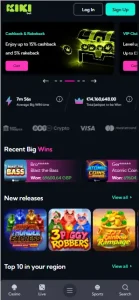
Kiki.bet registration, KYC levels and account safety
 Available in US

The registration details described for Kiki.bet include a username, password, email address, mobile number and the customer’s legal name. The operator states an 18+ minimum age and restrictions on multiple accounts within a household or from the same device or IP address.
Identity checks are described in stages: basic verification before the first withdrawal, followed by additional checks at stated cumulative transaction thresholds. The terms also refer to two-factor authentication and a retention period for verification records.

Table of Contents
- Key registration and verification rules
- Registration fields are linked to a genuine identity
- Verification levels depend on cumulative transactions
- Photo ID and statements support advanced KYC checks
- One account is permitted per person and household
- Two-factor authentication adds login protection
- Customer support handles account closure and self-exclusion
- Verification records remain for ten years after closure
- VIP points and cash-out caps belong to the same account
Key registration and verification rules
Registration details must correspond to a real account holder, because the payment rules require funding methods in that person’s name. Depending on the verification stage, the operator may request photo identification, proof of address or financial records. A two-factor login option is described as an additional safeguard.
The reviewed rules restrict duplicate accounts and set deadlines for requested verification documents. Support is described as available by live chat and email. Account closure and self-exclusion are different actions and should not be confused with ordinary customer-service requests.
Registration fields are linked to a genuine identity
Kiki.bet registration requires the user’s real name and contact details. The account form collects an email address, a mobile number, a username and a password. The registered name ordinarily cannot be changed after creation; corrections to an error are handled through customer support. That rule connects account access with the name used on payment instruments.
| Field | Function |
|---|---|
| Real name | Account identity and matching payment holder |
| Email address | Account contact information |
| Mobile number | Telephone contact information |
| Username and password | Credentials used for account access |
| Minimum age | 18 or a higher applicable local age requirement |
Kiki.bet distinguishes registration credentials from later identity evidence. A username and password provide a sign in route, while account verification checks the underlying person. The brand’s payment system also requires the card or wallet holder to match the registered name.
Verification levels depend on cumulative transactions
Kiki.bet performs level-one checks before a first withdrawal. The initial level covers full name, address and birth date, alongside identity screening. A second level starts at £2,000 in total deposits or withdrawals and a third at £5,000. Cryptocurrency and higher-risk circumstances can activate stricter thresholds.
| Level | Trigger | Typical checks |
|---|---|---|
| One | Before first withdrawal | Personal identity and screening |
| Two | £2,000 cumulative transactions | Identity evidence and address details |
| Three | £5,000 cumulative transactions | Source-of-funds evidence |
In higher-risk cases, the second and third thresholds fall to £1,000 and £2,000 respectively. The higher verification requirements are linked to total transaction activity, rather than to a single withdrawal. Its withdrawal controls additionally require the payment destination to match the account holder.
Photo ID and statements support advanced KYC checks
Kiki.bet may request a passport or identity card with a photograph, proof of home address, birth details and financial documents. Level two can involve nationality, place of birth and an identifying number; an address bill or statement may need to be no older than six months. Level three checks how the funds were obtained.
- Personal details: the initial check covers the registered full name, address and birth date.
- Identity evidence: a photo ID can be required with all four corners visible.
- Residential evidence: a utility bill or statement supports an address check where requested.
- Financial evidence: bank statements, payment-card photographs or proof of employment and business income may accompany higher checks.
After a threshold is reached, Kiki.bet allows 30 days for the necessary documents. Transactions are paused while the check is outstanding.
One account is permitted per person and household
Kiki.bet limits registrations to one account per person, household, IP address and device. The policy combines individual identity with shared-location and device identifiers. A member of a household may therefore fall within the one-account condition even though their personal email and username differ from those of another household member.
Kiki.bet prohibits deposits made with another person’s card or electronic wallet, linking the one-account policy to payment ownership across its products.
Login credentials provide access to the account, while the one-account rule concerns who owns it and which identifiers can be associated with it. Kiki.bet allows corrections to a mistaken registered name only through support, consistent with its identity-matching controls.
Two-factor authentication adds login protection
Kiki.bet supports two-factor authentication, or 2FA, for the account. This adds an extra verification factor to the username-and-password login process. Kiki.bet encourages 2FA for account security and checks transactions and identity information.
- Credentials: a username and password are associated with each registered account.
- Extra factor: 2FA provides another confirmation step for account access.
- Identity: Kiki.bet connects changes and payment requests to the registered person’s details.
Kiki.bet applies both login protection and staged KYC to the same account, including access from its mobile website and browser app.
Customer support handles account closure and self-exclusion
Kiki.bet offers self-exclusion through support for periods ranging from six months to five years. An agreed exclusion cannot be reversed early. Account closure is available on request, and a customer closing an account because of gambling difficulties is asked to identify that reason. Those arrangements belong to the operator’s own account controls.
- Support contact: live chat operates 24/7 for account and customer-service questions.
- Support email: [email protected] handles customer assistance.
- General contact: [email protected] covers organisational queries.
- Exclusion period: six months through five years, requested through support.
Kiki.bet also supplies a self-test as part of its gambling-control material. Closure requests may involve payout checks on remaining funds and account records. Help is also available from the independent National Gambling Helpline via the compliance information in the footer.
Verification records remain for ten years after closure
Kiki.bet retains verification documents and transaction history for ten years following the end of the customer relationship. The retention term continues beyond closing the user account and covers records gathered for identification and financial checks. This includes information used to establish the name, address and source of funds at the relevant KYC level.
The ten-year retention term is separate from the 30-day period for submitting new documents after a KYC threshold is reached. The two periods govern different stages of account handling.
Kiki.bet shows GBP as its principal account currency and EUR in some game displays.
VIP points and cash-out caps belong to the same account
Kiki.bet applies account-wide withdrawal limits of £1,000 each day, £4,000 each week and £10,000 each month. Progressive-jackpot awards sit outside those ordinary ceilings, and top VIP status can bring exceptions. Higher transaction volumes also activate additional identity checks at the brand’s KYC thresholds.
The loyalty programme described in the material has 25 levels and awards points based on real-money wagering. Those rewards do not replace identity checks, change an account’s legal eligibility or remove standard deposit and withdrawal conditions.
Kiki.bet combines identity checks, 2FA and loyalty levels with its payment account. Its casino games and sportsbook share the operator’s account controls, including the payment-owner matching condition.